
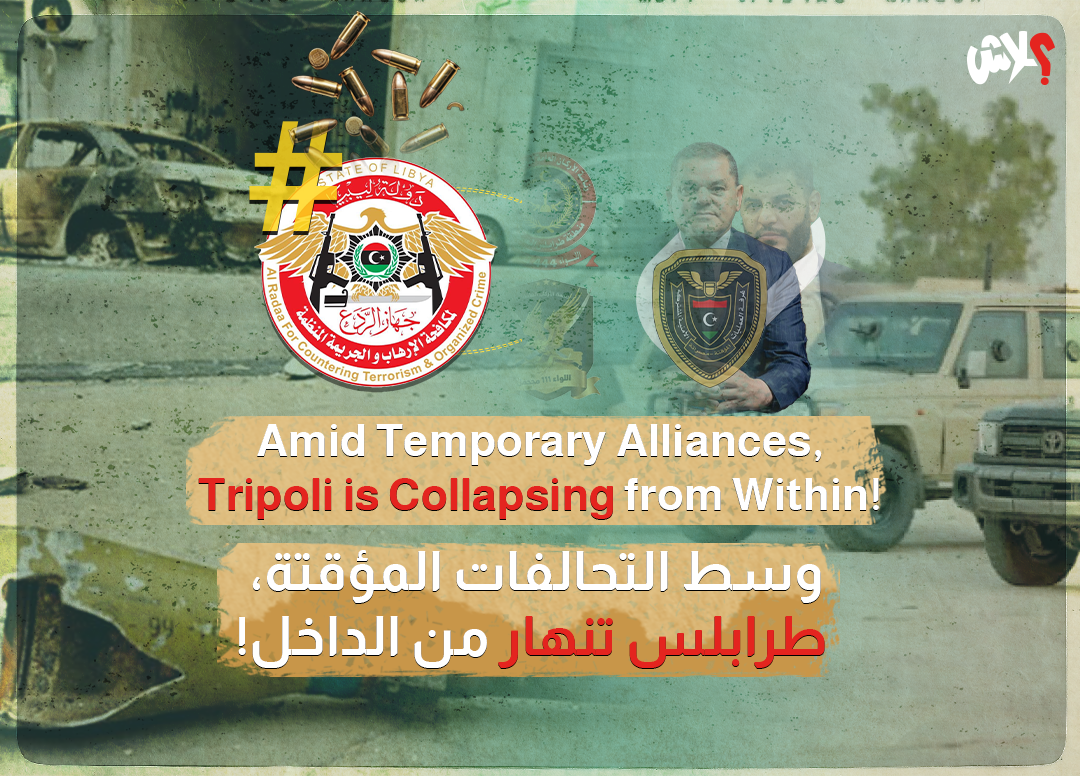
Amid Temporary Alliances, Tripoli is Collapsing from Within!
In the heart of Africa, a self-proclaimed “holy army” was born in 1987 the Lord’s Resistance Army in Uganda. It raised God’s banner, yet knew nothing of heaven except its name.It was nothing more than an armed faction that murdered childhood, kidnapped souls, and preached the Ten Commandments while its hands dripped with the blood of innocents. Between fabricated prophecies and rifles, madness took the form of sanctity, the killer became a preacher, and abduction became “salvation.”
Since the dawn of humanity, war has always been a tool of politics, surfacing when human interests clash and no peaceful arrangement can secure them. Then, violence becomes the mechanism to impose a new reality one that achieves goals unreachable through negotiation. I know this may sound obvious, but it must be repeated for Libyan citizens sitting at home awaiting their fate to remind them that those fighting today are not driven by stability or patriotism, and that their hope is misplaced.
So, let us ask: What is the point of this war today? And what will it actually produce?
Each faction has its own calculation. There are no genuine alliances only intersecting interests shifting weekly, sometimes daily. This is made clear by the government of “Reviving Life,” when Abdulhamid Dbeibah succeeded in convincing some armed groups in Misrata that his removal from power would erase the city’s influence in Tripoli’s executive decision-making arena. He argued that al-Zoubi commander of the 111th Brigade without the Defense Ministry cloak he currently wears, could not safeguard Misrata’s interests going forward. Therefore, advancing toward the capital and dismantling the existing armed formations particularly the Stability Support Apparatus and the Special Deterrence Force (Radaa) would ensure control over the capital’s political center.
Zintan, after a visit by the interior minister of the “Reviving Life” government heading a delegation of the city’s notable figures to Misrata, was presented with the idea of a genuine alliance between the two cities to manage the power vacuum once a Tripoli-based faction falls. This meeting took place before the military campaign led by the 444th Brigade and the 111th Brigade against Ghnewa’s forces after his killing, followed by attempts to eliminate Radaa. Zintan represented by Al-Trabelsi and his brother understands well that this alliance with Misrata’s armed factions guarantees its survival in Tripoli. They are not seeking territorial expansion; they only want to maintain a foothold in the capital to secure a place in any upcoming political bargain regarding executive authority. They also know that if Radaa and the Stability Support Apparatus outlast Dbeibah’s government, they themselves will be pushed out of Andalus, Siyahiya, and Al-Serraj areas they currently control where they lack a social base. Any organized military offensive would return them to the Red Hammada desert.
Many observers believe that the movement of the 444th and 111th Brigades to dismantle Radaa and the Stability Support Apparatus aligns with American demands to reduce the security congestion within the capital. These brigades promoted themselves as quasi-state military institutions capable of reorganizing Tripoli’s security landscape.
Before this operation, both brigades were positioned on the outskirts of Tripoli; now they have entered the city’s urban core, expanding their influence over executive decision-makers and enlarging the territory under their control.
Today, the Special Deterrence Force (Radaa) is fighting a literal war of existence. After absorbing the initial blow when 444 and 111 advanced toward its headquarters to dismantle it, Radaa used the truce to reorganize its ranks, redeploy across the neighborhoods it had retreated from, and impose a new reality: anyone who wants it removed from the city center must wage a ferocious urban war across Tripoli’s districts something there appears to be an international veto against. Moreover, Radaa shifted the confrontation from Souq al-Jumaa outward, meaning that if forced to retreat, the battle will take place beyond its core strongholds giving it the space to manage the fight with far greater composure.
Meanwhile, its opponents who withdrew from central Tripoli would require tremendous bloodshed, destruction, and civilian displacement to uproot it.
Many analysts argue that the Misratan forces assigned to “de-escalate” the conflict are merely a shield covering the Misratan-led operation from behind, while the 444th and 111th Brigades front the stage. They lack the capacity to stop aggression from either the government-aligned forces or Radaa. Tripoli appears too narrow to contain all sides; a decisive war is inevitable even if delayed.
Within this context, cold logic stripped of emotion says: the militia paradigm is indivisible. If the Stability Support Apparatus and Radaa are labeled militias, then this definition necessarily applies to the 444th Brigade, the 111th Brigade, Al-Jahawi’s forces, the Joint Force, Al-Hissan’s forces, and the rest of the formations sharing the same foundations and practices. Their only difference lies in the names of their commanders. The absence of one will not create stability its victorious replacement will simply recreate the same storyline, using the same blind shells.
The Lord’s Resistance Army, with which we began, kept its name and the world continued to call it that. Using its name does not imply the world’s acknowledgment of the divine narrative it crafted; rather, whatever name a group calls itself sticks to it, for better or worse.
So, do not be deceived by today’s titles or reputations. In truth, they are not so different from the Lord’s Resistance Army.
And so, dear citizen arm yourself with patience these days.
And whatever you do, do not repeat your mistakes.