
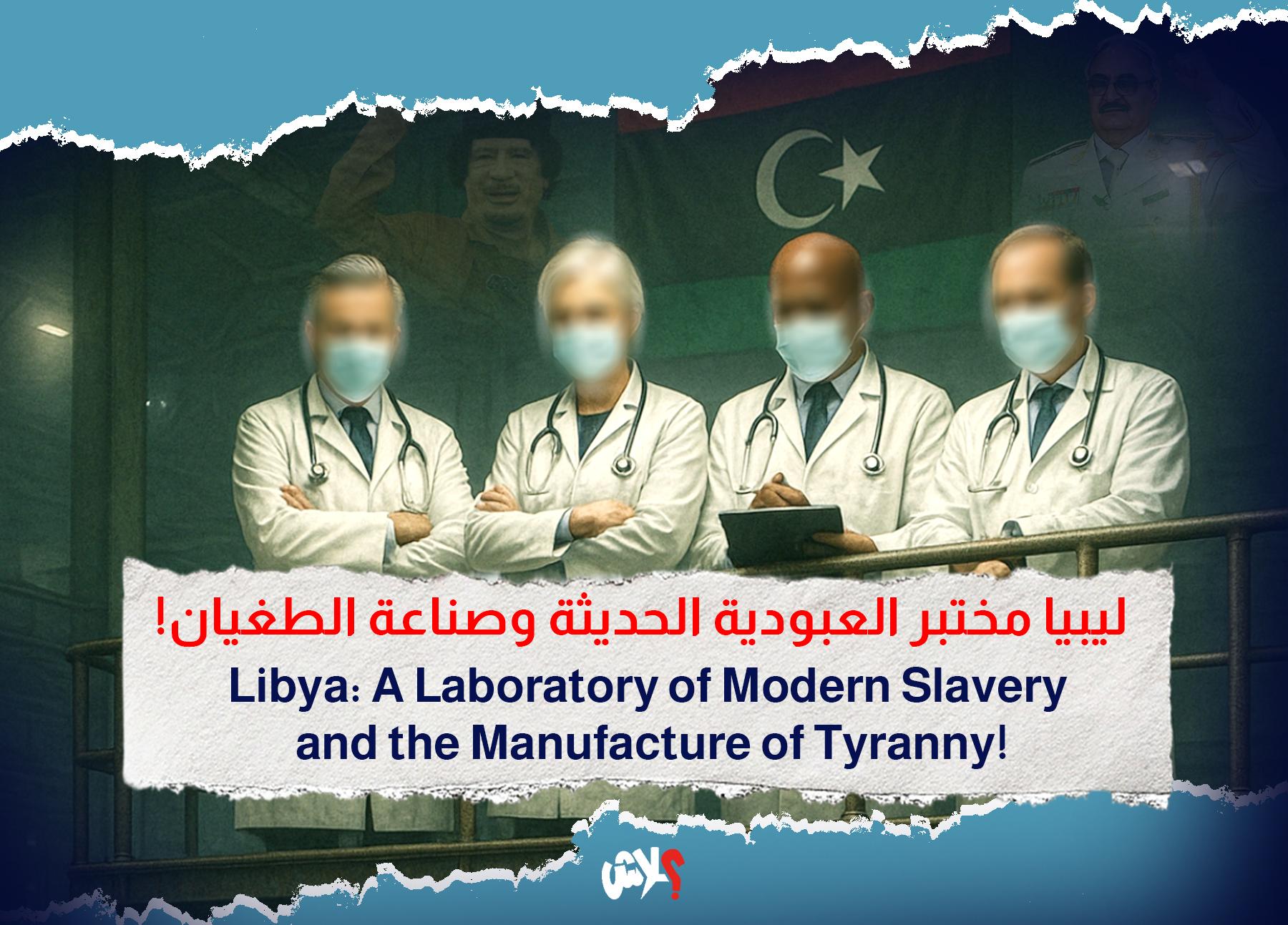
Libya: A Laboratory of Modern Slavery and the Manufacture of Tyranny!
Five centuries ago, the French philosopher Étienne de La Boétie posed a perplexing question in his book “Discourse on Voluntary Servitude”;
Why do millions of people accept submission to a single tyrant, despite their ability to liberate themselves simply by refusing obedience?
Since then, many have written about this idea, and perhaps one of the most brilliant works is “The Nature of Despotism and the Destruction of Enslavement” by Abd al-Rahman al-Kawakibi, who analyzed the personality of the tyrant and the collective mentality of submissive peoples. He argued that the tyrant is weak in reality, but derives his strength from people’s ignorance of this truth, and their willingness to settle for false security rather than risk rejecting obedience.
History has given us and still gives hundreds, perhaps thousands of examples confirming this, among them the Libyan model before 2011, and today, more than 15 years after Libya rid itself of its tyrant and executioner, it still presents especially in its east a contemporary laboratory for these ideas, where power manifests through militia-based semi-military and tribal loyalties, not through genius or strength of leadership.
La Boétie asserts that a tyrant does not need exceptional intellect or physical strength, but rather a network of loyalties offering blind obedience through which he consolidates his existence.
In eastern Libya today, this idea takes shape through the alliances of tribes and militias that pledge loyalty to Khalifa Haftar. The man’s authority does not stem from remarkable charisma or eloquent rhetoric that captures hearts and minds, but from his ability to distribute privileges in the form of money, positions, titles, and ranks to secure loyalty among local elites.
Here, the dictator becomes merely a symbol his details drawn by the powers surrounding him and he practices daily repression through followers who fear losing their privileges more than they fear the tyrant himself.
La Boétie paints an image of the dictator resembling a seated giant, deriving his strength, dominance, and might from a carefully curated image in people’s minds through disseminating his pictures, statues, and quotations from his supposed wisdom.People then feel he is present everywhere nescapable.
Today, in his areas of influence from Sirte to Tobruk the propaganda machine reinforces Haftar’s presence through social media platforms, television channels, huge street banners, and video clips showing him as a reformist leader walking comfortably in streets closed hours before his arrival inspecting massive projects executed by companies and funds run by his sons and sons-in-law.
This image not only reinforces his authority, but transforms him into an inseparable part of the collective identity of his followers and territories of control, where criticizing him becomes equivalent to treason indeed he becomes the nation itself.
This visual repetition driven by his media narrative entrenches acceptance of his presence and the consequences of his eternal rule exactly as La Boétie described when he said:
“The more the tyrant’s image embeds in the collective subconscious, the less need there is for material force.”
Abd al-Rahman al-Kawakibi writes in “The Nature of Despotism and the Destruction of Enslavement”:“The masses are the tyrant’s strength and his instrument;with them he attacks and dominates;he enslaves them and they rejoice at his power,he seizes their wealth and they praise him for sparing their lives,he humiliates them and they exalt his rank,he incites some of them against others and they boast of his cunning;if he squanders their money, they call him generous;if he kills some without mutilation, they deem him merciful;he drives them to mortal peril,and they obey for fear of reproach and if some noble souls revolt, he slaughters them as though they were rebels.”
This image is one we have seen in Libya before and still see today but why don’t Libyans revolt?
Political thinkers like La Boétie, al-Kawakibi, and others believe that liberation begins when people refuse submission but uniting people in Libya behind refusing obedience is not simple.
Many factors obstruct it: the collective memory of the chaos after Gaddafi’s fall in 2011 the rise of militias, the collapse of services, the emergence of bloody extremist groups used as a pressure card to justify tyranny leaving some to conclude:“The tyrant is a necessary evil.”
What further justifies the tyrant’s existence in some minds is tribal and militia-based divisions and the fierce competition for influence weakening any momentum toward solidarity against power a dynamic the regime exploits to justify itself.
Despite all this, the solutions proposed by political philosophers such as peaceful revolution through refusal of obedience seem difficult in Libya today.Yet the existence of seeds of change cannot be denied.
With rising awareness of mechanisms of domination and the emergence of voices rejecting the choice between tyrant and chaos, a new phase of cultural resistance may begin one that dismantles image-making, exposes the falsity of security narratives, and redefines freedom outside the binary of servitude versus disorder.
A comparison between propaganda imagery in eastern Libya and that of the Gaddafi era reveals continuity in the mechanics of crafting the “leader-symbol.”
And as history teaches, it repeats itself but hope lies in the future as long as there are those bold enough to refuse obedience and reclaim the identity of the people and the land pulling both from under the cloak of a dictator whose followers told him:“You are the people and the people are you.”