
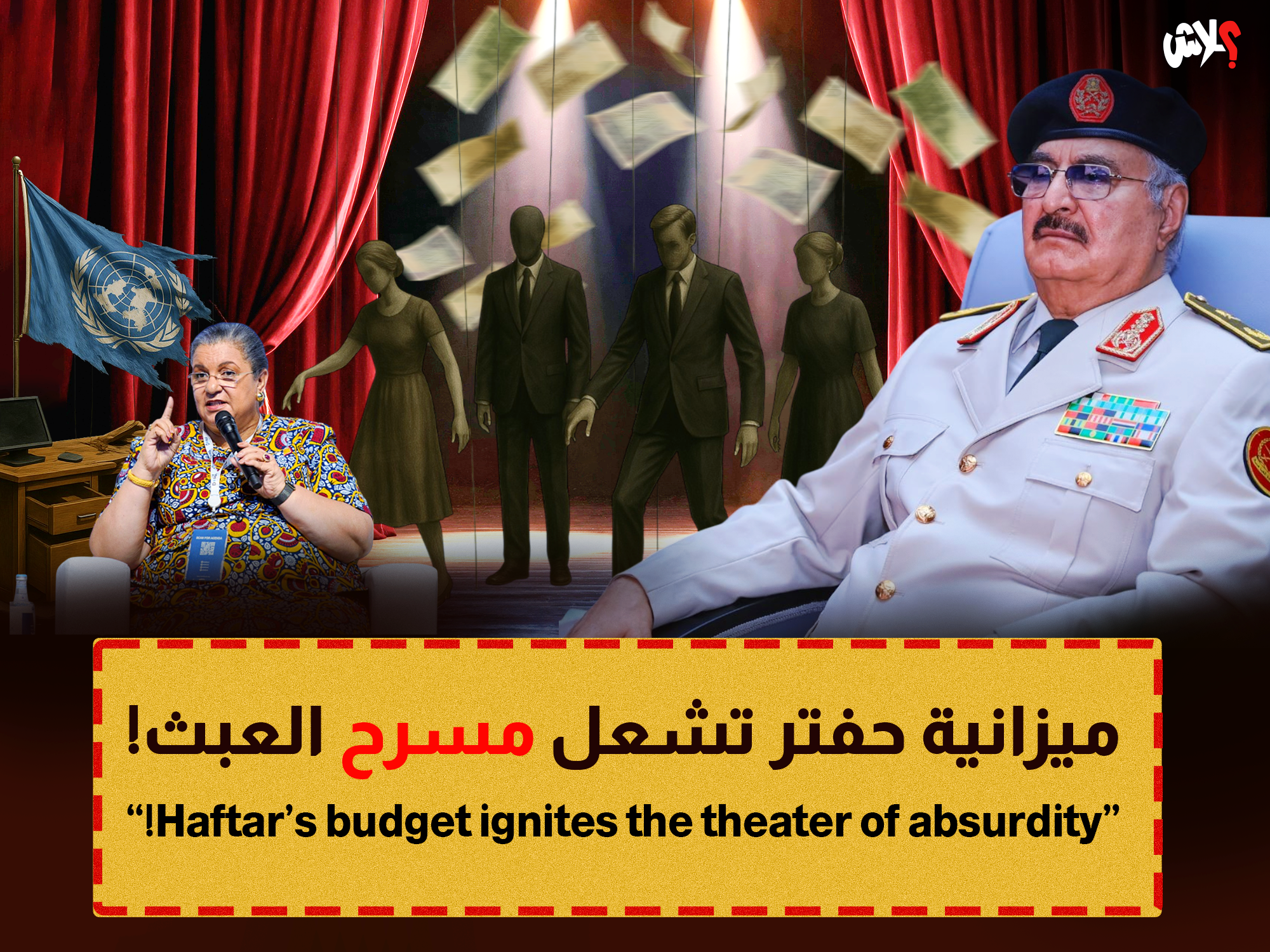
“Haftar’s budget ignites the theater of absurdity!”
We live in Libya today in a situation not far removed from what literature describes as black comedy addressing tragic or shocking themes (death, war, crime, suicide) in a sarcastic or humorous tone to expose the absurdity of reality or its bitter contradictions.
What reminded me of this was a farcical scene starring the head of eastern Libya’s government, Osama Hammadi, who appeared flexing his muscles, threatening to expel the UN Support Mission in Libya on grounds that it is no longer welcome citing what he called popular anger expressed by a group of demonstrators who stormed the mission’s headquarters in Janzour, in western Libya.
Although we do not truly know whether the storming of the mission was linked to Hammadi’s inflammatory rhetoric, or whether it was simply a spontaneous protest that escalated the mission considered the eastern government’s statement an incitement to violence against it, unhelpful to Libya’s cause, while praising what it called the discipline of government forces in handling protests in Tripoli.
Some observers might see the storming of the mission following its head Hannah Tetteh’s briefing before the Security Council as evidence of deep penetration by eastern Libyan forces and authorities into the west since no party in Libya appeared upset by Tetteh’s briefing except the followers of Khalifa Haftar and the polishers of his sons’ boots.
So why did citizens in western Libya storm the mission?
In fact, Tetteh said nothing new, except criticizing the massive budget allocated by the House of Representatives to the so-called Libya Development and Reconstruction Fund chaired by Belkacem Haftar.
This raises a question: who in western Libya benefited from storming the mission after it criticized eastern authorities?
But in this article, we are less concerned with answering that question than with showcasing the features of black comedy in our absurd scene. Hammadi previously described by his direct rival Abdulhamid Dbeibah as a “background extra” unworthy of being named did not erupt in outrage at Tetteh and her mission except when she spotlighted the danger of a vague budget being pushed in favor of the ruling family in Cyrenaica.
She warned of its threat to currency stability and inflation control, and the likelihood that the Central Bank would fail to preserve the exchange rate, the strength of the Libyan dinar, and therefore the sustenance of millions of Libyans.
The tragicomic part is that the mission expressed fear for us, while the man whom some regard as prime minister insults it for expressing that fear, calls for its expulsion, and incites against it!
The mission has since its creation facilitated dialogue among Libyans and led goodwill initiatives to resolve the political crisis but in the past it imposed its agendas without broad consensus: from the political agreement and the Government of National Accord produced by Bernardino León, to the Geneva Forum and the Government of National Unity produced by Stephanie Williams.
Even so, eastern opposition to the mission was usually reserved, and its stance generally aligned with events. We never heard this hysterical tone toward the mission until it criticized a decision by the House that her criticism may have no effect on approving or rejecting and why did Belkacem Haftar not criticize Tetteh’s remarks? Why did he not comment at all, despite the fund being his and the budget his?
Why do we never hear such harsh rhetoric from the Haftar family only “wisdom and rationality” in dealing with external actors while others rush to defend them whenever their name is mentioned, rightly or falsely?
When the UN mission pointed to the incitement by political figures against its headquarters, it did not name anyone explicitly. We do not know whether this was political prudence or disregard for Hammadi refusing to mention him just as his rival once did.
But this refusal to name turned him into an advertisement card and so the brave hero rushed to unleash his fury on the UN mission, accusing it of failure to achieve progress for more than ten years, despite his silence throughout those years when he served as a Trojan-style finance minister under the GNA, then as a background-extra prime minister under Haftar and Aguila.
Among the ironies is his justification of the attack on the mission as a natural expression of public anger at its performance forgetting that public expression of anger at his failure and that of his handlers means chains, torture to death in the basements of Internal Security, and bodies thrown lifeless on Zayt Street.
For more immersion in black comedy Hammadi, his circle, and his handlers incite demonstrations against the UN mission as an expression of public anger and against Dbeibah’s government for the same reason while the very same act, if directed at them, is treated as a monstrous crime requiring execution, chaining, or sometimes a fatal fall from a “high window while trying to escape prison!”
In another scene of the same farce, Hammadi exploits the general atmosphere in Tripoli to stoke the attack on the mission, then accuses the mission of failing to manage a file whose key levers belong mostly to his handlers forgetting that the Libyan street wants comprehensive change for everyone in the scene today, including him and his patrons.
Everyone knows the instigator of the mission storming is nothing but a puppet someone’s hand inserted beneath it moving its lips as if it speaks — while the real speaker stays offstage.
Everyone knows he is nothing more than a background extra as described by his rival in a play in which the starring role is reserved for the heroic leader who deems responding to trivialities beneath him, and so he moves his puppet to express his thoughts, appearing himself as the dignified wise man above trifles.
Everyone knows neither the instigator nor anyone else can utter a word without permission from their handlers.
Everyone knows the mission never worked genuinely for Libya or Libyans and no one ever attacked it until it acted against the interests of the ruling family then it became the target of their followers’ arrows.
And everyone knows that any nation governed by its scoundrels and wretches is destined for ruin for it has lost the conditions of survival and rebirth.