
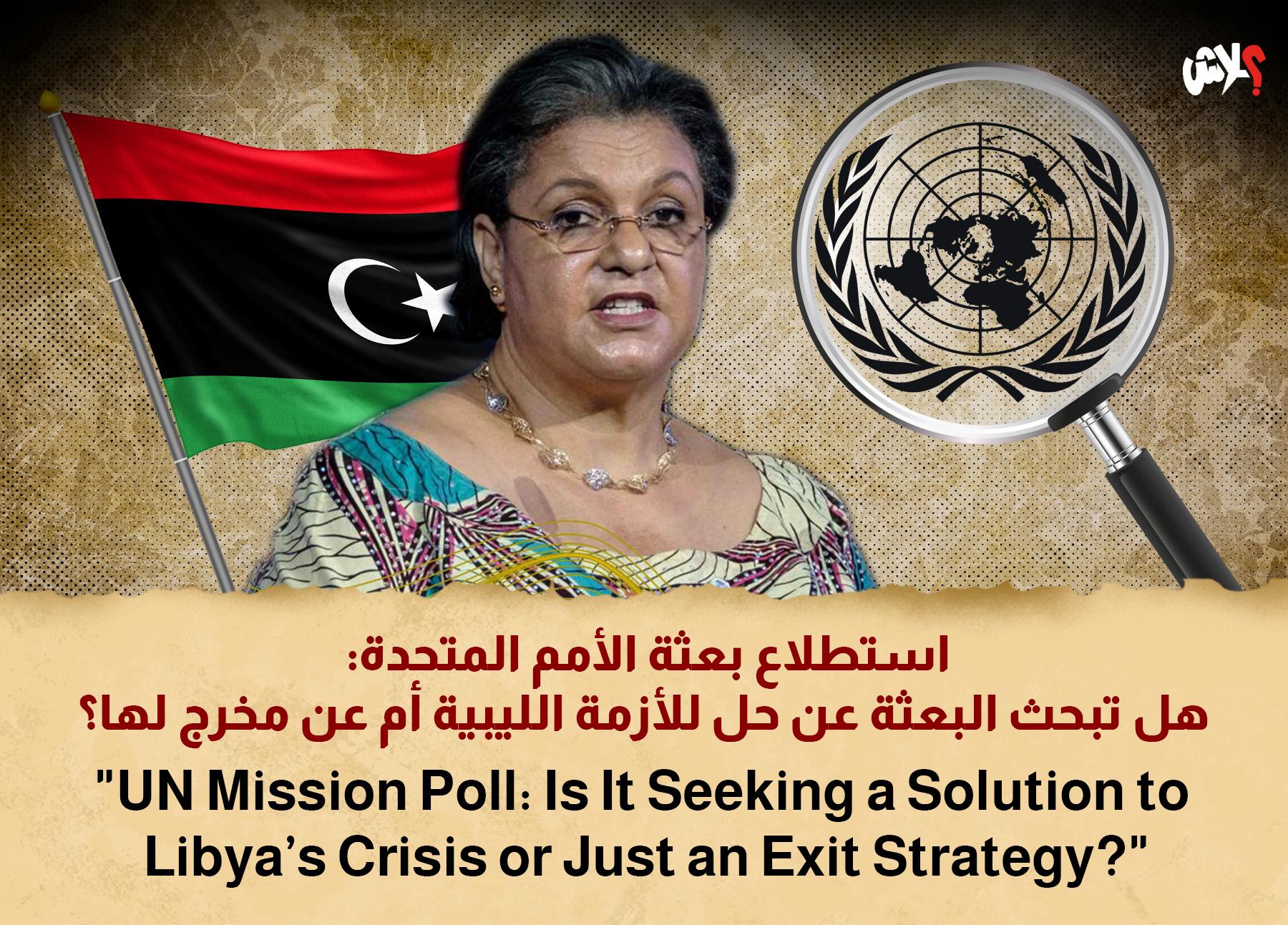
"UN Mission Poll: Is It Seeking a Solution to Libya’s Crisis or Just an Exit Strategy?"
The United Nations Support Mission in Libya issued a statement a few days ago, saying it had completed a wide-ranging opinion survey that lasted several months. It spoke to thousands of Libyans from different regions, and concluded they demanded “elections” and rejected “extension” for governments and councils conclusions that surprised no one.
But the question that imposes itself: Why all this effort, time, and money to learn what we all already know?
Any Libyan living on this land suffering from division, corruption, and lack of services knows people want to elect those who govern them, want to end the state of non-state, and want to stop the monopoly of power and wealth.
The statement came at a very sensitive time, just days before the briefing of the head of mission, Hanna Tetteh, before the Security Council as if the mission invested all this effort to produce a blank sheet, showing it had listened to the street before presenting a report that is unlikely to say anything new.
The Security Council briefing that Tetteh will submit next week will attempt to appear anchored in this survey. The ready narrative will be that the Libyan people want elections, while spoilers procrastinate. Phrases such as “political solution”, “political will”, “ending division”, “prudent spending”, “fighting corruption” and other ringing expressions will be repeated. The briefing will also warn of the risks of the current situation and may name some individuals, but it will not impose sanctions on any spoiler, nor will it present a fundamental remedy to the problem of losers refusing to accept any election outcome.
We have seen this refusal firsthand just days ago through depriving citizens in dozens of municipalities of their right to elect their administrators so how can you believe that those who prevented the election of a local council with limited powers will allow the election of a president who might throw them in prison!
What awaits us is another briefing that condemns, demands, and warns then the meeting ends, everyone goes back to what they were doing, the Security Council remains divided, and Libyan actors know this well and know how to play on that division. Russia will support one side, Turkey another, and diplomatic rhetoric will clash in the chamber while conflict continues on the ground.
Is there a solution on the horizon?
The bitter truth is that finding a solution is no longer the primary objective for many actors both internal and external. The Libyan crisis has turned into an industry benefiting everyone except the Libyan people. Militias profit from arms trade and smuggling, politicians cling to worn-out chairs whose power barely extends beyond their eyesight, while intervening states sell weapons, deploy forces, expand their influence, and view real stability as a threat to that influence.
The tragedy is that the solution is known and simple. It does not need extensive dialogues, surveys, or briefings it only needs agreement on a fair electoral law, a consensus on guarantees preserving something for all parties, and an international deterrent presence that prevents spoilers from ruining the outcome. But the will is absent, because losers under the solution are more numerous and more powerful than potential winners.
The UN mission through its appointed officials, field rounds, broad surveys, and periodic briefings often appears like a doctor repeatedly diagnosing the same illness for ten years, re-writing the same prescription while the patient is dying in the waiting room. The question is no longer about diagnosis, but about the radical treatment the mission and its sponsors never dared to prescribe.
Will Tetteh’s briefing change reality?
Most likely not. The UN mission will continue circling within the same loop searching for an exit to manage the crisis, rather than a solution to end it. The exit may be another fragile agreement like Skhirat or Geneva, extending the life of the crisis and making it easier to manage for a period. But the solution will remain absent indefinitely because it requires courage neither the mission nor the guarantor states have shown. Libyans will continue waiting for the missing solution that restores their state, but it will not come because as the saying goes, “No one scratches your back like your own fingernail does.”
If Libyans do not impose the solution from within, the outsiders will not impose it for they profit from the crisis and have nothing to gain from solving it.