
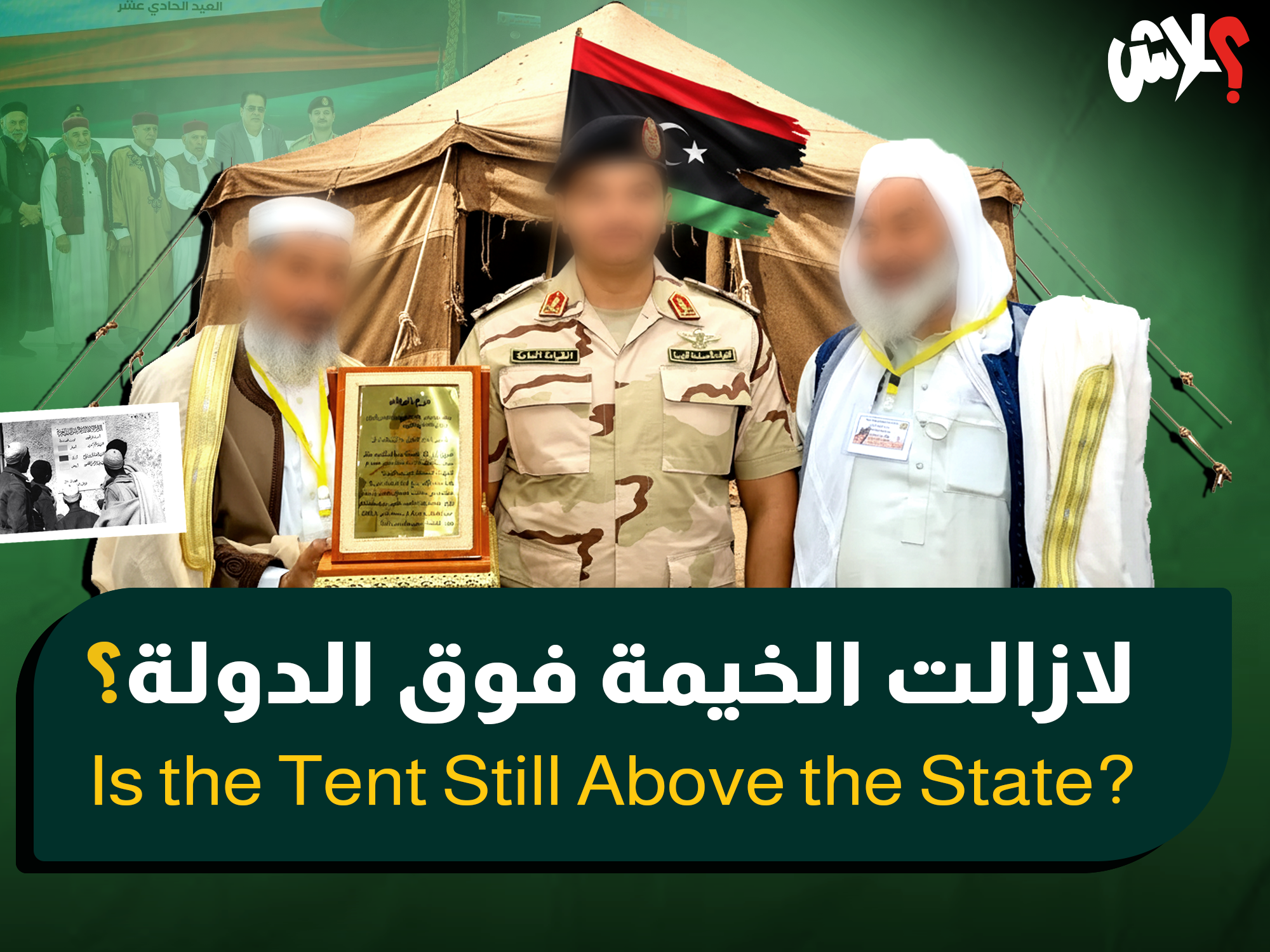
Is the Tent Still Above the State?
Libya has never witnessed in its modern or even ancient history clear features of a comprehensive state that behaves like a real state rather than a fiefdom or a subordinate province to a greater entity. And because the image of the state has continuously been absent, the primitive form of the tribe found fertile ground in Libya where it entrenched itself and asserted its presence even in periods where some features of a state appeared.
Since independence in 1951, and under the monarchy especially during Gaddafi’s rule after 1969 and even under the symbolic and transitional authorities after February 2011, Libyan rulers did not view the tribe and its sheikh as mere history, but rather as a mirror of their authority. The tribal sheikh, its knight, and its elder in Libyan consciousness represents the ideal model of a ruler who combines religious reverence, tribal leadership, and absolute authority. He is the reference that tribe members turn to in every matter his courtyard is their camel pen, their feast altar, the arena where they declaim poetry, fill their bellies, resolve disputes, stage rivalries, march to war, and submit to peace.
Thus, glorifying tribal heritage and customs became a symbolic language for justifying governance, for when a regime lacks constitutional or electoral legitimacy, it seeks an alternative one in heritage gathering tribal elders who pledge loyalty to him, making him in the eyes of the herd lord of their lords. The ruler ceases to be a mere official bound by law and accountability, morphing instead into a historical heir of authority above scrutiny granting him political sanctity without ballot boxes.
Systems rooted in tribal-military alliances believe Libya can only be governed through personal loyalty and customary relations just like traditional emirates and sheikhdoms where the emir or tribal chief was the center, while tribal councils formed the foundations of rule and where those close to him became the loyal elite. This structure persisted across eras from Idris Al-Senussi’s court, through Gaddafi, and up to the currently dominant authorities in the east and west.
Therefore, celebrating heritage by honoring elders, holding councils, and granting them minor powers is not respect for people’s customs but reinforcement of absolute authority derived from the ruler being the sheikh of their sheikhs and leader of their leaders.
Relying on tribes and their leaders to achieve or legitimize political gains is nothing new in Libya. Politicians and rulers have used this method since independence, through the Jamahiriya era, and into today’s chaos.
The marriage of convenience between state and tribe is as old as the state itself. Under the monarchy when signs of weakness appeared in the king and his heir and competition grew among his inner circle some advised the king to issue a decree dissolving political parties. The tribe then became the lighthouse guiding the (uneducated) masses in elections. Influential men of power imported thousands of tribe members from neighboring countries of course through their sheikhs presented as citizens returning home while the true motive was securing their votes, with promises of housing, work, and bright futures for their children. (Some descendants of these returnees still suffer today from incomplete citizenship procedures, while others still struggle with social stigma.)
After the monarchy fell and Gaddafi rose, one of his first actions was assigning members of his own clan to manage tribal affairs. He drew some tribes close, fueled hatred among others, crafting a fragile balance where the regime became a refuge tribes depended on for protection. Tribes began seeing the regime and its leader as the state itself. The legal definition of the state as system, land, and people was transformed into a political absurdity. Libya became a tribe whose sheikh was Muammar Gaddafi, who pitched his tent like any traditional tribal chief, receiving delegations of loyal sheikhs, congratulating dignitaries, and opportunistic poets. The state disappeared beneath the cloak of the “inspired leader” who claimed divine and popular mandate and was followed by millions until winds of change uprooted him one morning, just as they uprooted his predecessor.
With the changes after 2011, many imagined Libya would witness the birth of a civic state divorcing the tribe entirely but those hopes faded quickly. Tribes resurfaced, clinging to the robes of their elders, seeking positions and privileges in exchange for symbolic loyalty to new rulers. What became known as councils of elders (which replaced experts’ associations established under the previous regime) gained marginal powers in exchange for privileges that resurrected tribal influence.
After this long historical trajectory, the answer becomes vividly clear: the state and tribe are irreconcilable opposites, for as long as tribal loyalties remain the foundation, and as long as the tribal sheikh whose legitimacy stems from wealth, banquets, and relations is the citizen’s primary reference, a state will never rise.
Liberation from tribal dominance is not betrayal of heritage nor belittling of roots it is a prerequisite for belonging to a nation. The Libya we aspire to cannot be built on overlapping loyalties that place tribe above state, sheikh above law, and custom above constitution.
Either we choose a state of institutions and law or remain trapped in the pre-state loyalty vortex, which will yield only more fragmentation, weakness, and dependency.
The choice between tribe and state is essentially a choice between past and future, chaos and stability and Libya will have no future unless it becomes a state where law is the only sheikh, constitution the supreme custom, and the citizen the true leader.