
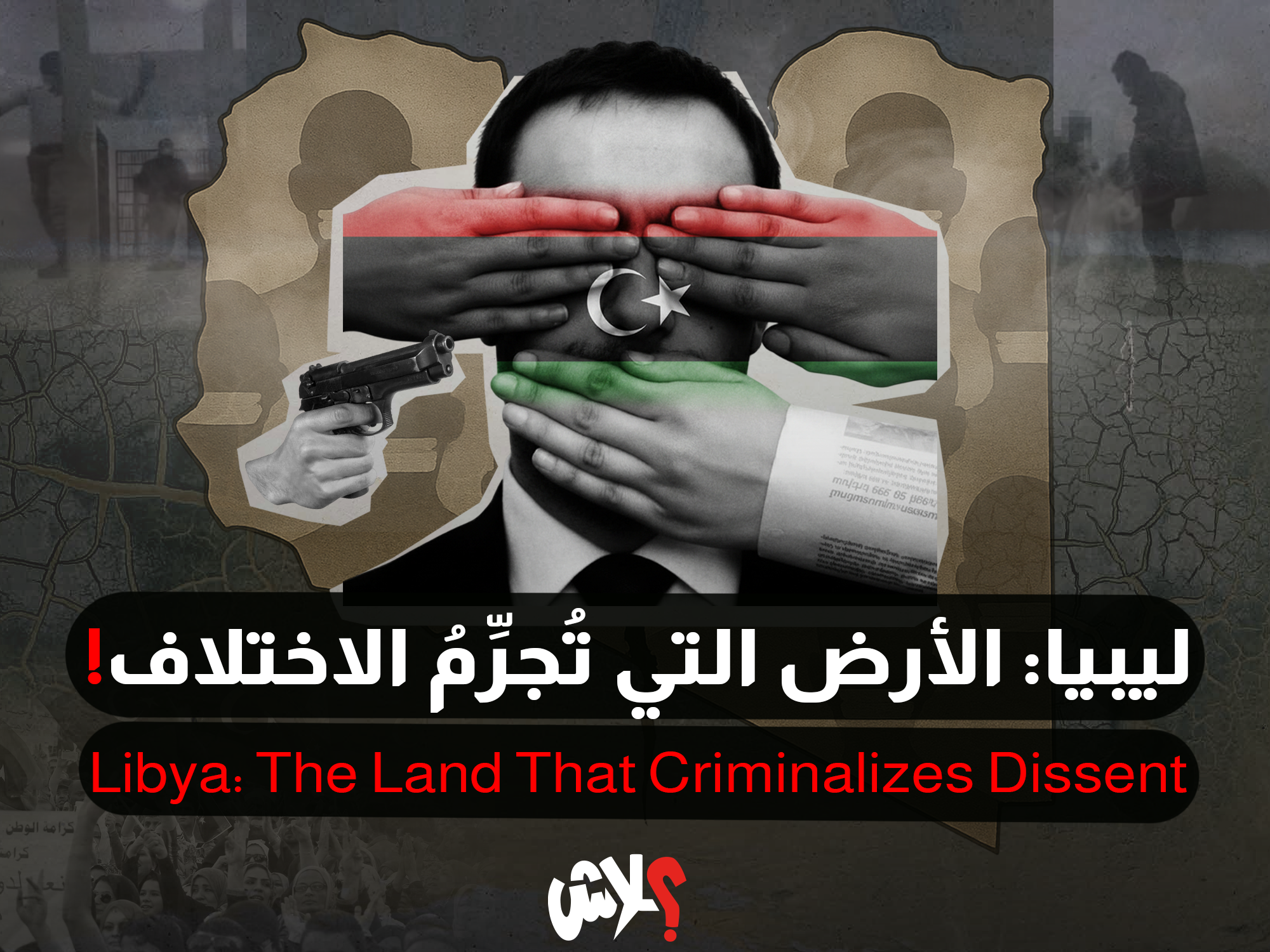
Libya: The Land That Criminalizes Dissent
Through following comments on what is written on our platform or on other news or analytical websites or even on social media pages dealing with public affairs it becomes clear that some among us believe the public sphere represented by the internet and social media pages is private property, registered in the land registry, with witnesses brought from among their supporters and followers, who outwardly raise slogans of freedom of speech, but in reality, it is a freedom with a single limit and one direction freedom that begins from their mouths and ends at their ears.
The moment you express an opinion that contradicts their desires, their comments pour in like a flood mocking your article, questioning your intentions, accusing you of ignorance or treason, and hurling at you the vilest insults as if they have just discovered that the writer is independent from them, has a different opinion, and is not their employee writing only to please them.
In Libya, which has been exhausted by division, we have come to treat differing opinions as if they were a bullet fired from an enemy’s weapon criticize the Dbeibah camp and you become an agent of Haftar; criticize the Haftar camp and you become a mercenary for the Dbeibahs and a puppet of Turkey or Qatar and between this camp and that, we continue to be thrown into boxes of classification and defamation.
The painful truth for you, dear monopolizer of truth, is that no one owns absolute truth. What you see as betrayal may be seen by others as patriotism; what you see as failure may be seen by someone else as success. People narrate the same event differently depending on their angles, backgrounds, and personal experiences an employee in the same institution in Benghazi sees matters differently than his colleague in Tripoli, and the farmer or shepherd in the Western Mountains has different priorities than a merchant in Misrata or Zliten.
Even international powers view Libya through different lenses serving their interests China, for example, aims to maintain balanced relations with all parties to protect its economic interests; whereas countries such as the UAE, Egypt, and Russia place most of their eggs in Haftar’s basket while keeping the door slightly open toward Dbeibah’s camp, and the opposite applies to Turkey and Qatar, along with Italy, albeit shyly each telling the story from its own interest-based perspective.
So why demand from us the impossible neutrality?
Ask us for honesty and objectivity.
To those demanding journalists and writers to be neutral, I say: absolute neutrality is a mirage an imaginary state that doesn’t exist. We all carry within us a history of personal experiences, affiliations, intellectual convictions, behavioral patterns, and upbringing that shape the lens through which we view the world. What is truly required is not neutrality it is objectivity and integrity.
Objectivity means presenting facts fully and not selectively, listening to both sides, and seeking accuracy.
Integrity means declaring your principled biases, not ignoring your opponent’s argument just because you dislike it, and admitting error when you are wrong.
This is the essential difference between a real writer who expresses his own view even if people disagree with him and a mouthpiece of power whose mission is to defend it and polish its image, saying only what its followers want to hear. The first aims to inform people, the second aims to mobilize them.
There are also people who view others through their own nature (every vessel leaks what is in it) they assume the writer must be just like them, a megaphone for authority or for a political faction. But the truth is that a real writer does not work for any of his readers his job is not to please the audience, but to provoke thought, raise questions, and perhaps unsettle the satisfied reader maybe that satisfaction is nothing but a mirage seen as water by the thirsty.
When authorities in the east or west prevent municipal elections in dozens of municipalities under flimsy security pretexts, the writer’s duty is to expose this farce not justify it. When civil society institutions are transformed from platforms for development and rights work into tools in the hands of rival factions, the duty of the writer is to uncover this infiltration not overlook it. When authority arrests, tortures, or kills someone for expressing an opinion, it is our duty to condemn it and insist it never repeats because one day we may be in the place of the person whose words were twisted by the regime and led to his arrest, torture, or death.
We must all know and acknowledge that the public sphere belongs to everyone; your voice is not louder than others, nor is your opinion holier than theirs diversity is richness, and difference is a law of life. As God Almighty says in Surah Hud:
(And if your Lord had willed, He would have made mankind one community; but they will not cease to differ except whom your Lord has given mercy and for that He created them)
In conclusion, dear citizen:
Whether you are an independent thinker or a follower of this camp or that, writers, journalists, and analysts are not your employees. They are not tasked with glorifying you or belittling your opponents. They are simply human beings trying through experience and awareness to open windows for thought.
So either read them objectively, analyze their opinions consciously, critique them knowledgeably or scroll past, knowing that not everything published will please you.
And always remember: the world does not revolve around you or your ideas and he whom you glorify and see as great may be to someone else more worthless than a fly.