
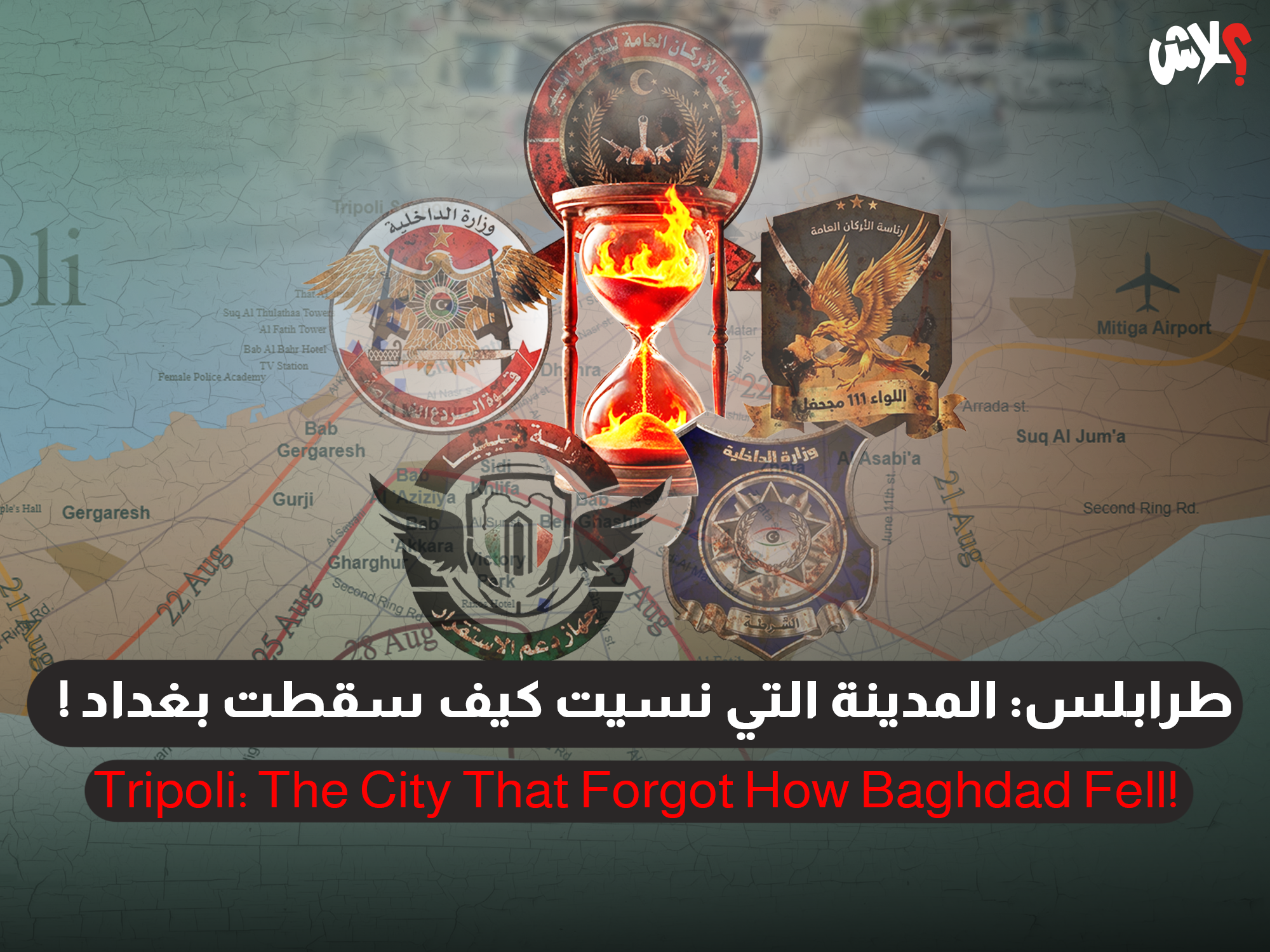
Tripoli: The City That Forgot How Baghdad Fell!
The fall of Baghdad at the hands of Hulagu in 656 AH was neither sudden nor a single blow that toppled a vast empire. It was the natural conclusion of long years of internal decay, division, and power struggle within the Abbasid house itself. Before the Mongols reached its gates, the state was already drowning in rivalries between ministers and military leaders, and the betrayal of the vizier Ibn al-Alqami, who weakened the army under the guise of reform, extinguished whatever authority remained for the caliphate.
Meanwhile, the Mongols marched westward, overrunning city after city Samarkand, Bukhara, Rayy, Hamadan until their armies reached Baghdad, a capital stripped of its backbone and army. When Hulagu besieged the city, there was no state left to defend it. The caliph surrendered, the Mongols entered the capital, and the scene that shook the Islamic world unfolded: mass slaughter, burning of markets and libraries, and thousands of books thrown into the Tigris until the river’s color changed.
Although the Abbasids built a state that ruled the world, and although I know it is unfair to compare that to what is happening in western Libya, we recall this analogy as a reminder more than a comparison for we have long been convinced that the inhabitants of this region passionately repeat their mistakes in the same order.
Many observers know that Brigade 444 and the Special Deterrence Force will not reach a stable peace agreement between them, and their struggle for influence in Tripoli and for territorial gains remains an ongoing, natural condition. While Brigade 444 seeks to extend its control over all of Ain Zara up to Al-Fernaj roundabout and seize all areas of Alsabba adjacent to Souq al-Jumaa the Deterrence Force’s stronghold the latter will not accept such an expansion. It views Ain Zara as its key strategic depth, and any future clash would place it in a militarily vulnerable position if it concedes that ground.
With Brigade 444 insisting on taking all of Ain Zara under the security arrangements set by the conflict-resolution committee, and with the Deterrence Force refusing this expansion and holding on to its numerous positions within Ain Zara, looming clashes in this area seem almost inevitable.
Meanwhile, the Public Security Agency, which controls the stretch from Souq al-Thulatha roundabout at the entrance of Hay al-Andalus municipality up to Al-Gheran roundabout bordering Janzur, is attempting to address the rising lawlessness. Residents of Tripoli wake daily to murders, executions in the streets, and armed robberies of shops and vehicles. It seems that the agency’s leadership backed by the Interior Minister, who claims this is the only area under his control and where the ministry’s “security plan” will be enforced is unable to restrain its personnel. Many observers believe this failure will accelerate what they see as an intended emptying of the capital from armed formations under Brigade 444 and Brigade 111, which are seeking to dominate most of Tripoli. What the security agency’s personnel are doing will simply make the expected attack according to many analysts a matter of time.
Battalion 55, led by Muammar al-Dhawi, positioned in Warshefana encircling Tripoli from the west, appears unlikely to survive in its current form much longer. Many observers believe that Brigade 111 is trying to assert full control over that area. Indicators emerged through recent clashes between Battalion 55 and a force aligned with Ramzi al-Lafaa, who led an armed group widely believed to have been supported by Brigade 111. After his assassination by individuals said to be his relatives, his group returned to attack Battalion 55, and the clashes did not stop until Brigade 111 intervened to halt them. The brigade’s ambition to control the area is logical its borders overlap with those of 55 and this development also fits within the broader effort to restructure the deployment of militias in Tripoli and around it. That restructuring began with dismantling the Stabilization Support Apparatus and its leader Gheniwa al-Kikli, the failed attempt to eliminate the Deterrence Force, and the renewed rearrangement of plans.
All of this is unfolding in western Libya, while the gradual expansion of Rajma’s project and the Haftar family in the west continues. In recent weeks, numerous western areas presented offerings of allegiance to Field Marshal Khalifa Haftar through their tribal elders from Zintan to Zawiya, the western coastal towns, Bani Walid, and others. It seems that the next attempt to enter Tripoli may be easier and calmer than the previous one, amid the dominant military forces in western Libya losing a unified vision, immersing themselves in internal rivalries, and failing to consolidate their ranks against what is coming from the east. Meanwhile, Rajma’s project successfully markets itself to Libyans as capable of imposing security and stability, while western citizens are exhausted by daily chaos that suffocates whatever remains of their lives and those of their children.
All indicators suggest that a total collapse of the security system in the region is inevitable. But the illusion of control blinds those leading it today just as the Abbasid caliph in Baghdad failed to see the Mongols advancing toward him, until the catastrophe struck!