
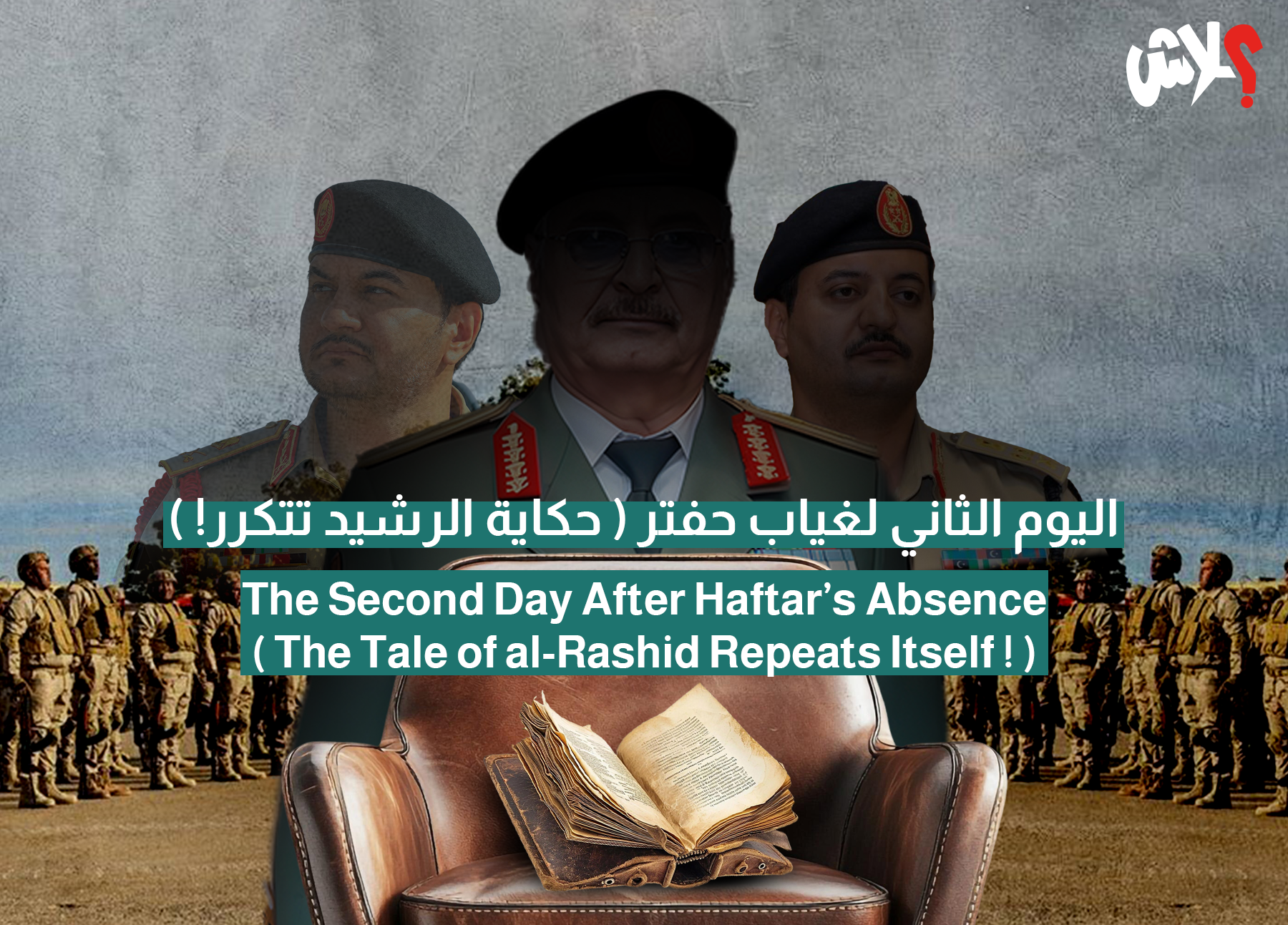
The Second Day After Haftar’s Absence (The Tale of al-Rashid Repeats Itself!)
At the end of the second Hijri century, Harun al-Rashid – one of the most powerful Abbasid caliphs – stood before the question that puzzled everyone who sat on a throne heavy with history, blood, and ambition: How could he ensure his rule continued after his death?
So he gathered scholars, judges, and notables, arranged covenants, drafted pledges, and divided the kingdom between his sons al-Amin and al-Ma’mun, believing that paper could silence swords, and seals could convince the ambitious to stand patiently in the silent queue of fate.
Yet confrontation was inevitable; power, when fragmented, does not calm, and when divided, does not settle even if it inherited the intellect, strength, and influence of al-Rashid.
Today, after more than a thousand years, history seems to brush the dust off itself and replay its ancient scene in Libya, but on a different stage, with different actors, and in a context and tools modern in appearance yet ancient in sequence. Here, on this land, people adore repeating experiences to the letter, with a certainty no one knows where it comes from that they will reach new outcomes no one before them did only to find that repetition ends as their breath runs out!!
You do not need a scholar today to know that the Rajma project was created to be inherited, all indicators said so, yet those who support it lie to themselves day and night, insisting it does not resemble all past ruling projects in the region denying this in an attempt to suppress the growing anxiety inside them from watching past replicas collapse.
But let us set that aside and think together about the fate of succession.
There is consensus among devotees of the Rajma dome and those living under its control, that leadership transfer in Rajma happened smoothly, that the House of Haftar accepted the division, that regional and international allies endorsed it, that the absence of Haftar in any form will not shake its continuity, and that the sons Haftar’s legitimate heirs are aligned in a scene resembling al-Rashid’s arrangement with injustice to al-Rashid in such a comparison!
When al-Rashid died, the fixed formula of absolute power on this land began acting by which I mean the courtiers and entourage of old, and the flatterers, drummers, and bag-carriers of today.
Senior figures around al-Amin, especially (al-Fadl ibn al-Rabi’), began pushing him toward breaking the pact.
They whispered that maintaining al-Ma’mun as crown prince with wide authority in Khurasan threatened his rule and that succession needed “re-arranging” in favor of his son Musa.
The scene does not differ much in Rajma, where both General Khaled Haftar (Chief of Staff) and General Saddam Haftar (the Field Marshal’s heir and youngest son) each have entourages presenting them as symbols of unity and leadership.
This is evident in their movements and media portrayal a clear sign that embers of competition over rightful inheritance remain unresolved in hearts only settled in media and surface imagery.
No guarantee exists that this arrangement survives after the Field Marshal leaves this life.
What strengthens the likelihood of conflict is the absence of any prominent Cyrenaic an military leadership in Rajma, after the Field Marshal and his sons emptied senior ranks and filled forces with new recruits whose loyalty is only to them many from outside Cyrenaica and Fezzan.
This is evident in Saddam Haftar’s recent dissolution of Brigade (Sabil al-Salam) aligned with the al-Zuwayya tribe in Kufra, and his removal of (Hassan al-Zadama) from Awlad Suleiman (dominant militarily in Sabha and surrounding areas) from command of Brigade (128), not to mention ending the influence of the Tebu, the core manpower controlling borders with Chad, Niger, and Sudan, by assassinating or imprisoning their leaders.
Meanwhile, Khaled Haftar presents himself today as the calm and rational son, with fewer mistakes and less violent conduct.
So far, no direct violations are proven against him all such reputations belong to Saddam while Khaled occupies himself with sponsoring public and sporting events, in addition to commanding Brigade (106) one of Rajma’s pillars which he continuously develops.
Haftar did not extract binding oaths and treaties from his sons as al-Rashid did he merely accepted a parliament paper naming his son as deputy and deputies in Libya can remain deputies forever
Just as al-Rashid believed pre-arrangement prevents conflict, some think succession engineering within armed formations can produce stability but anyone who understands the logic of power here knows that authority in this region obeys one rule:
power is never handed over voluntarily,does not stabilize through inheritance,
and history every time smiles mockingly at those who think otherwise.
We know well today what became of al-Rashid’s succession plan, and anyone with insight sees today where Haftar’s succession under his dome is heading but only the beneficiaries sell people another narrative one made of illusion.
That illusion will dissolve at dawn and because dawn always comes wait for I am waiting with you.