
“Oppressed nations decay in their morals, and when marginalization lasts long enough, man becomes like livestock caring only about food, drink, and instinct.”
These words were spoken by the scholar Ibn Khaldun centuries ago, but they are perhaps the most accurate description of Libya today as if he lived among us when he wrote them. What we witness and live is not merely a political or economic crisis, but a moral collapse eating through the roots of society. Humanity has become a cheap commodity; death is entertainment; murder is celebrated; and dancing over scenes of blood has become a daytime sport on social media without even pseudonyms as people gloat, justify, and threaten under their real names and photos.
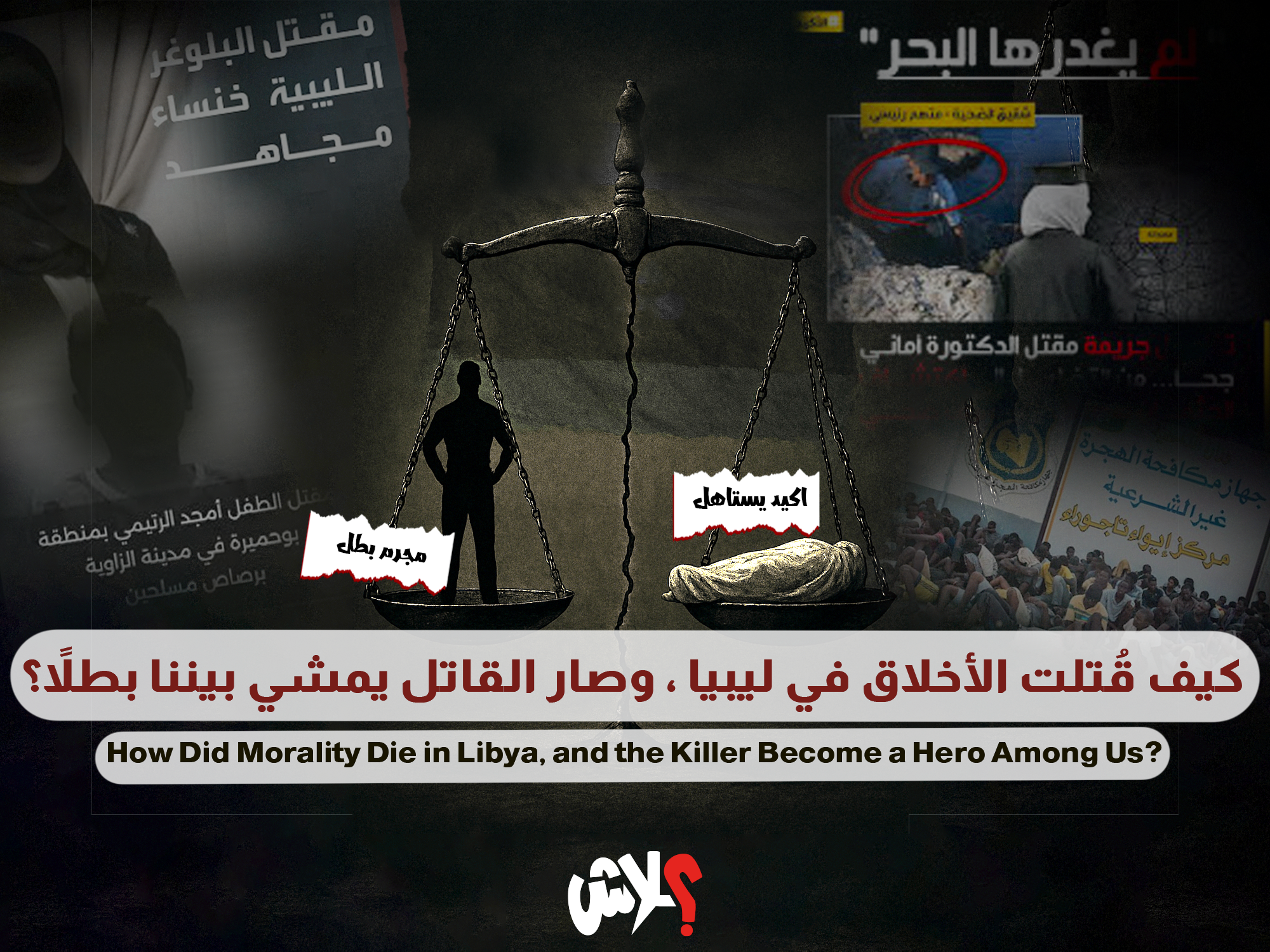
The murder of African migrants no longer deserves mourning. All it takes is for someone to claim that a migrant threw a stone at a car, and suddenly the killer becomes a hero, and the corpse thrown by fate into this miserable country becomes nothing more than a lesson for anyone who dares disturb Libyan cars.
The comments following the deliberate running-over of an African migrant were enough to shake the conscience of a nation chants of support, calls to repeat the act, congratulations to the killer for “cleansing the street” of “parasites,” and an explicit endorsement of shedding blood that is sacred by law, even if the victim has no legal protection in life or death.
In Misrata, the killers of the young doctor did not settle for taking her life they insulted public intelligence as well. They staged a comedy about sorcery, drowning, and searching for her body thrown into the sea by a wicked magician. People believed it, got angry, and comments rushed to accuse sorcerers, to demand expelling migrants!
When the truth unfolded that her own family betrayed her we immediately began searching for excuses to protect our delusional superiority: “We do not commit crimes without reasons (Surely she must have done something).”
The tragic irony is that society accepted the first story easily because it prefers to believe that magic killed her rather than admit that morality died in our homes before she did, and that we still search for a moral pretext to disguise the brutality that has become the norm.
When the young blogger Al-Khansa was assassinated, one would expect condolences and sympathy at least but what happened was shocking. The tragedy became a spectacle for mockery against her and her husband, with comments like Those who do nothing get nothing, and “She was one of those feminists,” and Good riddance, revealing a cancer of hatred eating through society. We can no longer tolerate seeing anyone live better than we do; instead of aspiring upward, we want those above us dragged down to our level.
What is worse is how killing, kidnapping, torture and gloating over victims have become opinions expressed openly. There is no barrier now between disliking someone and calling for their physical elimination.
Activists, politicians, journalists, ordinary citizens all can become “legitimate” targets overnight simply because they disagreed with the majority or dared to speak a truth or even a falsehood.
Ibn Khaldun was not predicting the future he was reading the laws of history. And Libyans today live under three layers of oppression: the oppression of power, the oppression of poverty, and the oppression of helplessness.
Years of war, corruption, and division made citizens feel they control nothing in their lives. When humans lose dignity and the sense of agency, they become selfish, aggressive, concerned only with survival.
The moral collapse we witness is not the cause of the crisis it is one of its results, a symptom of a broken society screaming in silence. But despair is not an excuse to abandon humanity. Descending to the level of beasts does not prove strength it proves we were defeated internally before any enemy defeated us.
The path to salvation begins with acknowledging the seriousness of the disease and that we need deep healing that starts not from the top, but from the base:
from our homes, our schools, our mosques, our daily awareness that life cannot function without ethics, that a nation cannot be built with hearts full of hatred and spite.
And that when Allah wanted to praise Muhammad He told him: “Indeed, you are upon a great moral character.”
The Libya we want will not be born from sarcastic comments, cyber-bullying, moral justification for crimes, or celebrations of death online.
New Libya needs a moral revolution one that restores conscience, human value, and dignity and before we reform the state, we must reform ourselves.