
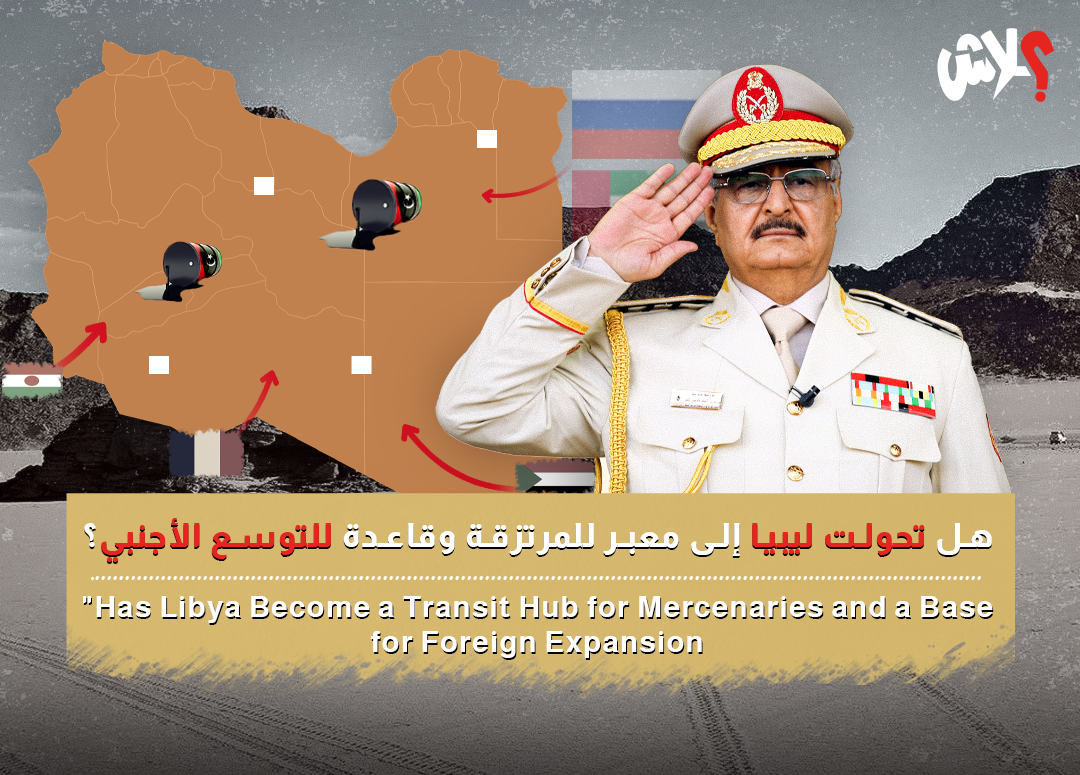
"Has Libya Become a Transit Hub for Mercenaries and a Base for Foreign Expansion
Since 2011 and until today, Libya has been one of the most significant hotspots of internal conflict in the region and perhaps in the world.
But due to the overlap of internal rivals with their foreign backers, whose interests intertwine with actors in other countries, the country has turned into a giant chessboard in a dangerous geopolitical game aimed at reshaping the rules of power across the entire region.
The scene is no longer limited to domestic power-sharing, but has evolved into transforming the country into a safe passageway for mercenaries and a launch platform for foreign military expansion, where Haftar, for instance, appears to trade his continued hold on power for the mortgaging of Libya’s wealth and sovereignty by turning it into a logistical hub for mercenaries deployed by his regional and international allies to active conflict zones.
Libyan territory especially under Haftar’s control in the east has become a core part of a complex logistical network funded by the UAE to support the Rapid Support Forces in their proxy war in Sudan.
The matter has gone beyond mutual accusations and political wrangling and has become an issue raised at the highest global levels especially after Sudan recently filed an official complaint, backed by evidence, to the UN Security Council, accusing the UAE of recruiting and funding between 350 to 380 Colombian mercenaries, most of them retired soldiers and officers, and shipping them to fight alongside the Rapid Support Forces.
Documents reveal that these mercenaries operating under the codename “Desert Wolves” are flown from the UAE to Puntland in Somalia, then to Benghazi, Libya, under the supervision of Haftar-aligned forces before crossing the desert into Sudan.
Reports also reveal that many of these recruits some barely past their teenage years are deceived with promises of legitimate, well-paid security jobs in the UAE (around $2,600), only to have their phones and passports confiscated upon arrival in Abu Dhabi, ending up in training camps in Darfur where they are forced into one of the world’s most brutal wars.
The use of Benghazi’s port and airport both under Haftar’s control as vital transit nodes in this network not only indicates highly coordinated cooperation between Haftar and his allies, but also exposes the fact that Libya’s sovereignty has become a tradable commodity turning the country into a conduit for illegal and bloody operations fueling the conflict in Sudan.
In parallel with the Sudan file, southern Libya represents another arena where Libyan sovereignty is weaponized in a power struggle this time for the benefit of a major power closely aligned with Haftar: Russia.
Russia, through formations such as Wagner now rebranded as Africa Corps exploits the security vacuum and weak central control in Libya’s south to establish informal military footholds.
These areas have become staging grounds for Russian operations and influence across the Sahel, including Chad, Niger, and Mali, where Moscow offers security services in exchange for economic concessions and political leverage.
Haftar appears to provide this Russian presence with legitimacy and protection in return for sustained military and political backing an arrangement reminiscent of Cold War-style proxy dynamics, where weak states served as battlegrounds for global rivalries at the cost of their sovereignty and stability.
Some may ask: what does Haftar gain from turning Libya into a military passage for his allies?
The answer lies in a political calculation rooted in reinforcing regional legitimacy.
By facilitating these operations, Haftar portrays himself as an indispensable partner to the UAE and Russia ensuring continued military and diplomatic support for his rule in the east.
He also seeks to fortify his domestic positioning because foreign backing gives him a decisive military edge over rivals in the west and shields him from meaningful international pressure for a political settlement that could cost him his authority.
Moreover, it bolsters his control over wealth, which strengthens his leverage at any future negotiation table or even allows him to monopolize power unilaterally.
Turning Libya into a regional logistics hub enhances his grip over national resources especially oil and ports and makes the country hostage to external powers that prefer dealing with him as the sole counterpart, rather than risking engagement with others tied to different international actors.
And as a Libyan citizen whose priority today is to secure daily sustenance for your family, the struggle for power and the country’s submission to foreign players may seem like a luxury concern but regardless of whom you support domestically, the safe passage of mercenaries through eastern Libya and the expanding Russian presence in the south are not trivial.
They represent a deliberate erosion of Libyan sovereignty.
In his bid to secure his rule, Haftar is not merely compromising Libyan territory he is fueling regional conflicts and collecting benefits today whose costs will be paid by future generations of Libyans.
He has turned Libya from a state of weight and influence into nothing more than a dirt road cutting through the desert of global conflict a role that benefits only the ruling elite aligned with him, while the Libyan people and the people of the region pay the price in their stability, security, and future.