
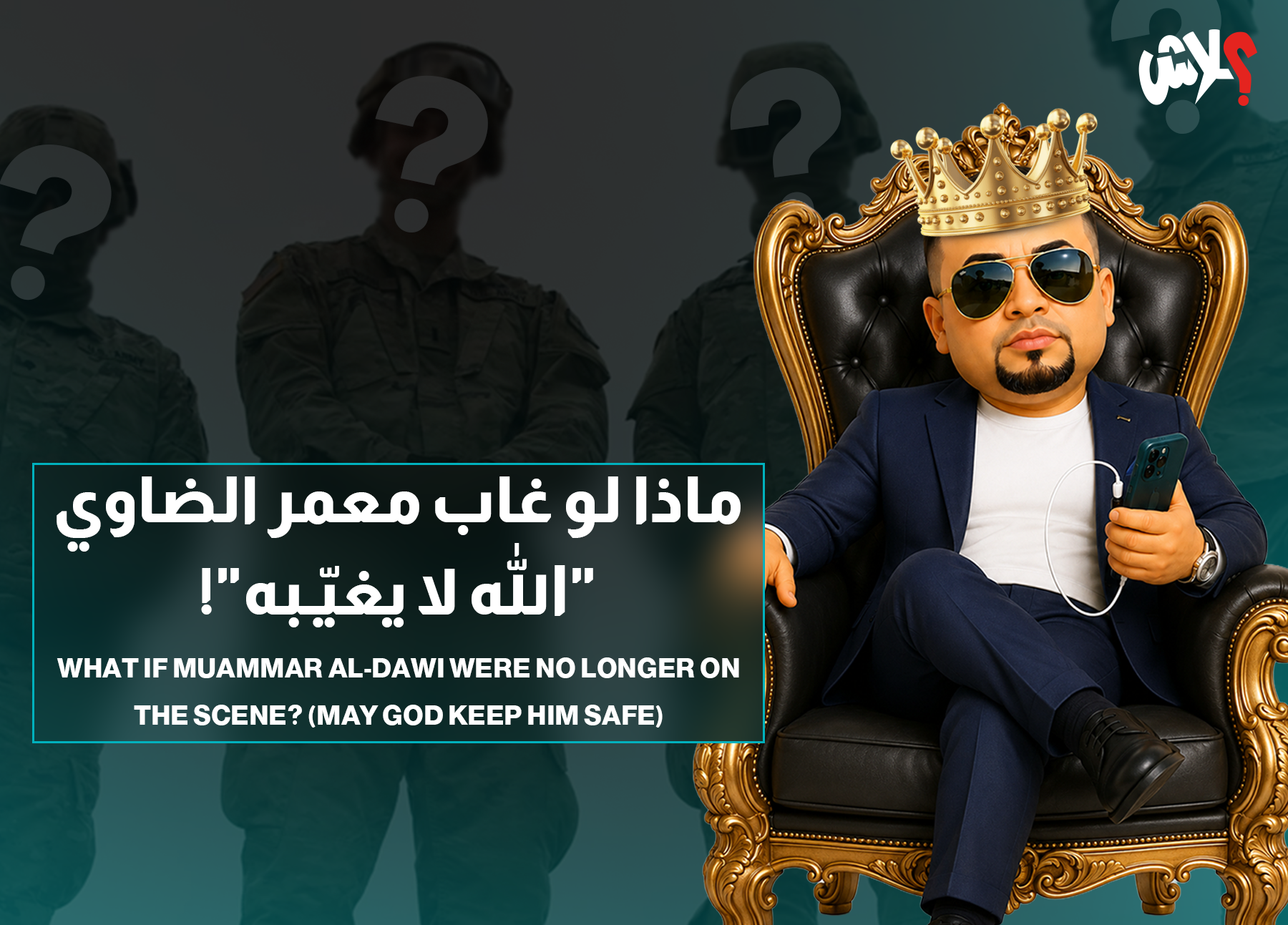
What If Muammar Al-Dawi Were No Longer on the Scene? (May God Keep Him Safe)
Anyone closely following Libya's security landscape understands that all armed groups in the country, despite their different names and structures, have gradually developed a set of customs and defining characteristics through which their evolution and ultimately their demise can be understood. We have previously referred to this body of unwritten rules as the "Jurisprudence of Militias," a concept that encompasses these accumulated patterns and norms.
According to the Jurisprudence of Militias, which holds that every armed formation is, by necessity, structurally tied to its commander, any disruption affecting that commander will inevitably affect the group's very existence and determine whether it survives or collapses. There may be one or two exceptional cases whose organizational structures do not depend on a single leader, but those remain exceptions rather than a general rule upon which analysis can be based.
It is important to begin with this introduction in order to explain the analysis that follows.
At this stage, Muammar Al-Dhawi, commander of the 155th Armed Formation in Warshefana, is reportedly suffering from a critical health condition that has prevented him from carrying out his duties as the head of an armed force controlling approximately four municipalities and a vast geographical area.
Given that there is no obvious successor to Muammar Al-Dhawi within his formation or within Warshefana itself today—after Al-Dhawi succeeded in unifying the area with the support of Al-Juwaili more than five years ago, this region, which endured years of severe security chaos affecting the entire western region, the capital Tripoli, and the vital coastal route extending to the Ras Ajdir border crossing with Tunisia, has become strategically important. Consequently, the stability of Warshefana carries considerable weight for the Dbeibah government in Tripoli.
As a result, a struggle is already emerging among armed groups based in Tripoli to expand their influence into the area, while certain armed formations in Zawiya are also monitoring developments and attempting to extend their control over the neighboring parts of the region.
In Tripoli, the General Security Apparatus appears to be seriously considering moving into Warshefana should Muammar Al-Dhawi disappear from the scene. The route extending from Hay Al-Andalus toward the mountains and onward to Zintan represents a vital lifeline for the apparatus, which is unwilling to allow any rival force to dominate this corridor. Should military escalation occur against it in the future, this route could easily be cut off. For that reason, the General Security Apparatus is keen either to control the entire area or, at the very least, to secure the road linking its headquarters in Tripoli with the Nafusa Mountains, ensuring that this strategic artery remains firmly under its control.
Meanwhile, the 111th Brigade views itself as Al-Dhawi's natural successor in Warshefana. Over recent years, the brigade maintained an indirect presence through "Ramzi Al-Lafaa," a member of the Awlad Issa tribe who operated along the geographical boundary between Tripoli and Warshefana. Al-Lafaa enjoyed the brigade's support for several years until he was unexpectedly killed during an internal conflict, creating a vacuum in influence within Warshefana. Consequently, the brigade commanded by Al-Zoubi, the Deputy Minister of Defense in the Dbeibah government believes it is best positioned to secure the region, thereby expanding its influence throughout western Libya while strengthening its standing within Tripoli itself.
As for the 444th Brigade, many believe it harbors significant ambitions to enter Warshefana. However, some observers argue that the brigade would prefer to intervene only after conflict has already erupted, presenting itself as a stabilizing force or as a formation seeking to halt the fighting among the competing groups attempting to seize control of the area. Such a scenario would provide the 444th Brigade with a greater degree of public acceptance in Warshefana an advantage that might not be available to those formations that rush prematurely to claim Al-Dhawi's legacy.
On the western side of Zawiya, another armed formation affiliated with the Abu Zriba family whose member serves as Interior Minister in the Hammad government also seeks to ensure the security of its own borders. It may therefore advance toward adjacent areas to guarantee that whichever formation eventually controls Warshefana does not establish a direct presence along its own frontier.
All of these scenarios could be facilitated by individuals already serving within the 155th Armed Formation itself. Some observers believe that members of the formation's second-tier leadership may have already begun communicating with the various armed groups expected to enter the region, suggesting that they may ultimately hold the key to control of the area and that their role could prove decisive.
This is simply an analysis of possible scenarios that could affect the stability of the region as a whole. Al-Dhawi may well return to his position fully recovered from his health crisis. What remains significant, however, is that the lives of ordinary citizens living in this region have become dependent upon the health of Al-Dhawi and others like him commanders of armed formations scattered across the country, regardless of their names or uniforms.
And let everyone living under these conditions understand one thing: the person responsible for making their lives and future dependent upon the health of this commander or that one is neither Al-Dhawi nor anyone else like him, but rather everyone who accepted this reality and contributed to its continuation.