
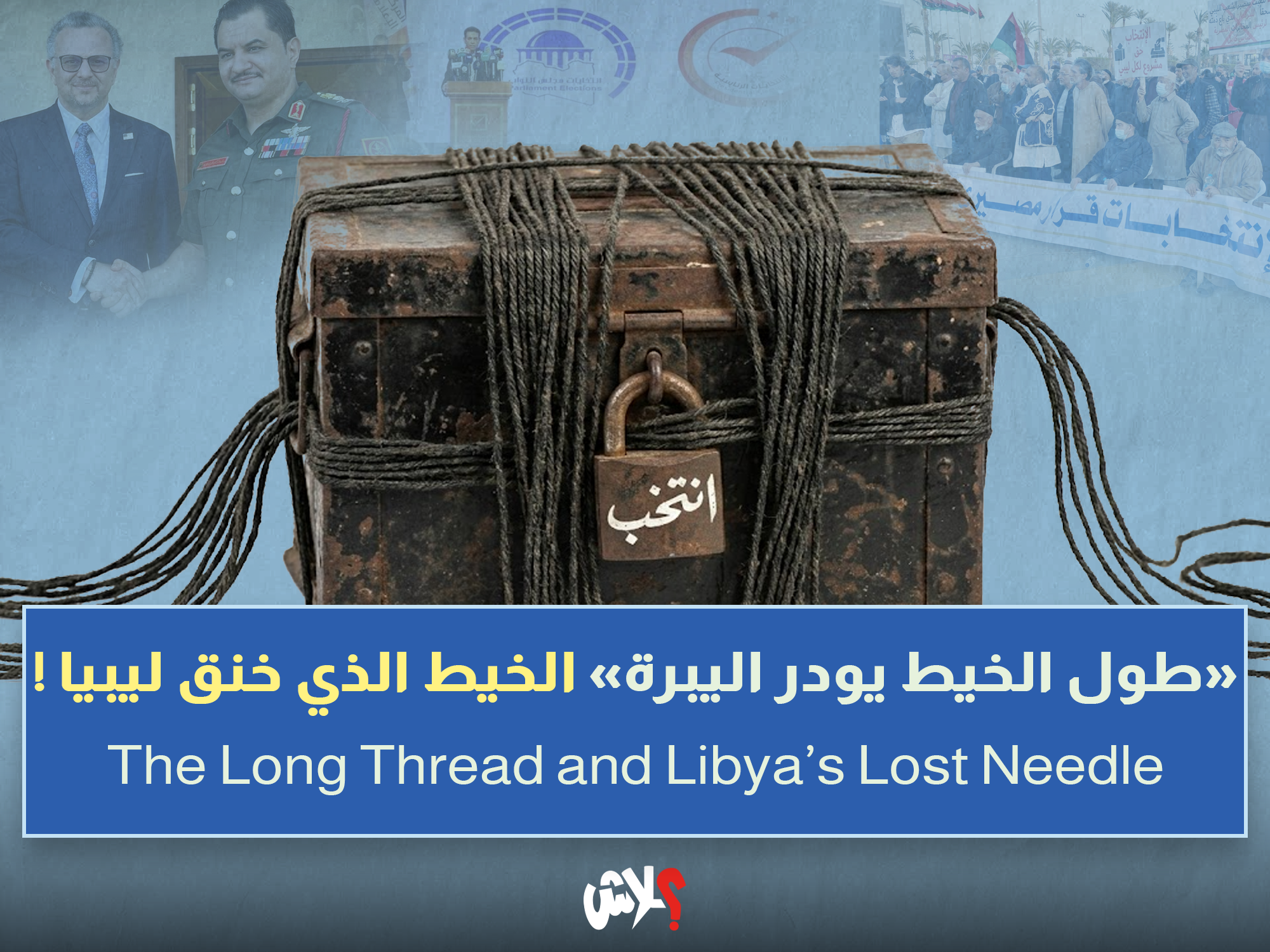
The Long Thread and Libya’s Lost Needle
A brilliant Libyan proverb perfectly captures our current reality: "The longer the thread, the easier it is to lose the needle." The more the tailor lets the thread grow longer and more tangled, the slimmer the chances of finding the needle, until it disappears among the folds and seams. In Libya's case, the "needle" is none other than the long-awaited elections upon which Libyans pinned their hopes of mending the torn fabric of legitimacy. Meanwhile, the successive political initiatives are nothing more than that ever-lengthening "thread," deliberately stretched by political tailors not to complete the stitching, but to lose the needle altogether and prolong the crisis indefinitely.
Anyone who carefully observes the Libyan scene quickly realizes that examining the consequences is enough to understand the causes. The repeated failure to hold elections was never the result of technical shortcomings, logistical obstacles, or force majeure, as was repeatedly claimed. It was the direct product of the lack of genuine commitment among the dominant actors. Fear, anxiety, and panic took hold of the authorities controlling eastern and western Libya alike, terrified by the possibility of losing elections—and with them, their power. Other figures, sitting atop the leadership of the House of Representatives and the High Council of State, became convinced that sincerely moving toward the ballot box would amount to political suicide. After ruling the political landscape through de facto authority for more than a decade, it is inconceivable that these figures would willingly return to political obscurity. Given this undeniable reality, it becomes remarkably naïve to expect these very actors to oversee free and transparent elections while fully aware that genuine elections would almost certainly remove them from power through overwhelming popular will.
Within this context, we can understand the recently announced agreement and roadmap between the House of Representatives, the High Council of State, and the Presidential Council to organize elections before 17 February 2027. In reality, this loud announcement is nothing more than a political maneuver and a carefully crafted deception devoid of genuine credibility. The leaders of these institutions acted out of deep fear that the United Nations Support Mission might ultimately bypass them through the "Structured Dialogue." They therefore moved preemptively, pursuing a strategy built upon two separate threads:
The first thread: mobilizing their own representatives participating in the Structured Dialogue to reject its conclusions in advance and accuse the UN Mission of imposing pre-packaged solutions and foreign formulas upon the Libyan people.
The second thread: introducing a supposedly "locally produced" roadmap claiming to lead Libya toward elections within eight months. Yet this roadmap is so vague that even members of the two councils themselves have not been informed of its details or behind-the-scenes arrangements. It was, in effect, stillborn behind closed doors.
This political acrobatic act carried out by the leaders of the three councils did not go unnoticed by Khalifa Haftar and his General Command in eastern Libya. Haftar well known for carefully reading both allies and adversaries quickly announced his acceptance of the American initiative led by U.S. presidential adviser Massad Boulos, while simultaneously rejecting every other proposal. The next stage of the scenario followed almost immediately: the very next day, his allies and political instruments within the House of Representatives commonly referred to today as the "General Command MPs" declared their full endorsement of the Boulos Initiative, describing it as the "only viable path out" of the current crisis. The tragic irony, however, is that only days earlier the so-called Boulos Initiative had been little more than political gossip circulating among ordinary citizens in their gatherings and waiting lines. It had never been officially announced or transparently presented to the Libyan public, whose future it is supposedly designed to determine.
The motives behind this behavior are as clear as daylight. Haftar, now advanced in age and approaching the end of his political career for "natural and biological reasons," understands perfectly well that his sons have virtually no future ruling Libya through free and direct elections. Consequently, his alternative strategy is to secure his family's continued rule through the notorious power-sharing arrangement known as the "Boulos Initiative." At its core, this initiative is not a national project at all, but rather a partnership agreement designed to divide power in Libya and with it, the country's future between two dominant families: the Dbeibah family, which controls financial power across western Libya, and the Haftar family, which rules eastern Libya through military force.
What stands out amid all this political noise is the silence worthy of a family tomb. Speaking of the Dbeibah family, its most prominent member, Prime Minister (Abdul Hamid Dbeibah), has remained completely silent. He has neither commented on Haftar's acceptance of a power-sharing arrangement with him despite previously denying that such an initiative even existed nor reacted to the announcement by the three council presidencies regarding elections scheduled for early next year. It is as though none of this concerns him, or as though silence itself constitutes the agreed price for allowing the deal to proceed.
But how much further can this thread be stretched?
Today we stand before a complete political tragedy. We know with certainty that at least for now the Boulos family deal has no realistic prospect of implementation. We know with even greater certainty that no elections are visible on the horizon, neither in 2027 nor in any of the years beyond. It has become abundantly clear to anyone paying attention that all these initiatives, roadmaps, consultative meetings, and dialogue rounds held in regional and international capitals amount to nothing more than carefully designed maneuvers aimed at prolonging the crisis and buying time by deliberately extending the thread so that the needle remains forever lost.
Yet while we know all of this beyond doubt, what we do not know and what fills our hearts with genuine fear for Libya's future is how long this wounded country, together with its depleted oil and financial wealth, can continue to withstand the greed of those currently in power and their systematic plundering.
How much longer will the state and its exhausted institutions be capable of providing the bare minimum of salaries, public services, and livelihoods before comprehensive economic and social collapse finally descends upon everyone?
They stretched the thread until it strangled the nation. The needle disappeared beneath the weight of their narrow interests, leaving the fabric of Libyan legitimacy torn apart and scattered by the wind, waiting for a miracle capable of returning the needle to its rightful place and the thread to its proper length.